
RELATED
 Selecting an AC Backward curved Centrifugal Fan for cold storage roomsSep 16, 2026
 Centrifugal Fan Selection Guide: Application and SelectionAug 18, 2026
 How to Size an AC Wall Mounted Axial Fan for Airflow and Static PressureAug 07, 2026
 Guarded Axial Fan Manufacturer Direct – Selection Guide for Condenser & Cold Storage Fans | Wholesale PricingAug 03, 2026
 Commercial Kitchen & Bathroom Ventilation Fan Selection Guide | Metal Inline Duct Fan & Wholesale Hotel Ventilation FanJul 22, 2026
MESSAGE
Effective control of fan operating noise begins with precise installation specifications. This article systematically elaborates on the key points and installation steps for noise reduction of metal duct fans.
Structural Noise Control: Installation and Vibration Isolation
Structural propagation is the main cause of fan noise amplification. During installation, priority should be given to selecting vibration isolation devices that match the fan's
mass and speed, such as neoprene shear seats, spring isolators, or elastic pads. The natural frequency of the isolator should be at least three times lower than the fan's
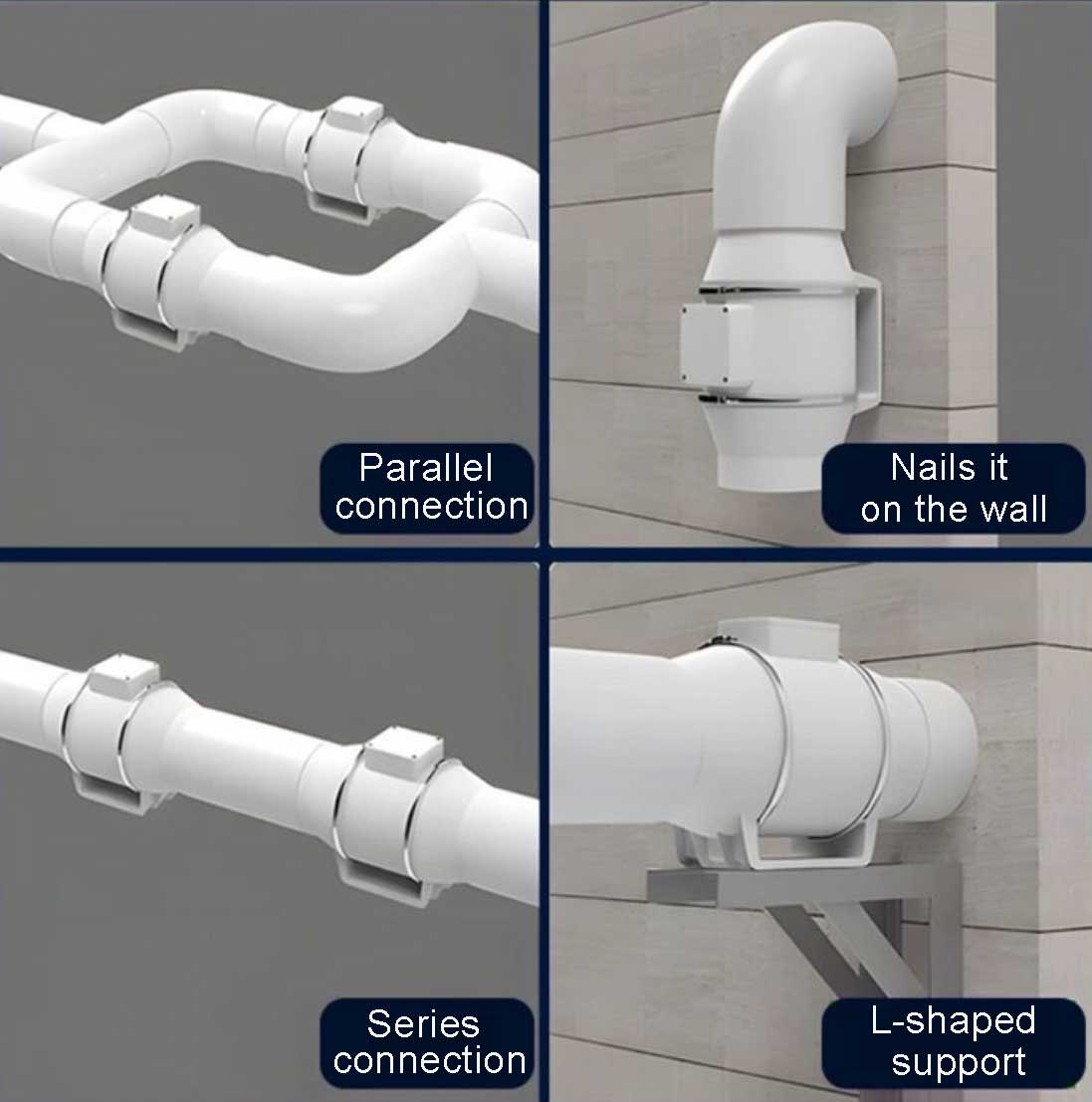
operating frequency to avoid resonance. Flexible connectors or neoprene corrugated pipes should be installed at the inlet and outlet to isolate the fan from the rigid duct.
Mechanical fastening should be performed according to torque specifications to reduce contact points.
Details are equally crucial: anti-vibration pads should be applied to metal contact surfaces, and flexible hangers should be used for suspended installations. Direct-drive fans
in long ducts require independent support sections to prevent weight transmission to the duct panel. If radiated noise is significant, additional mass-loaded vinyl ester or
constraint layer damping materials can be applied. During commissioning, accelerometers should be used to detect vibration and verify the vibration isolation effect. These
measures can significantly reduce structural noise transmission without affecting fan performance.
Aerodynamic Noise Optimization: Duct Design and Airflow Balance
Turbulence is the main source of aerodynamic noise. A straight duct section of 3–5 times the pipe diameter should be maintained before the fan inlet, and 5–7 times the
diameter after the outlet, avoiding sharp bends, abrupt changes, or proximity to valves. Elbows should use a large radius design with guide vanes; if necessary, rectifier
grilles or plenums should be installed to balance the flow velocity.
For noise-sensitive scenarios, a frequency-matched silencing section can be configured downstream. Fan selection should strictly adhere to the system resistance curve;
excessive or insufficient resistance can easily induce turbulence or high-pressure noise. Through pressure drop and Reynolds number simulations, the fan and operating
point can be accurately matched, suppressing broadband and tonal noise at the source.
Continuous Quiet Operation Guarantee: Commissioning Strategies and Maintenance
During the commissioning phase, baseline noise and silencer insertion loss need to be measured, and speed, voltage, and static pressure parameters need to be verified.
Variable frequency drive is recommended to avoid resonance speed ranges and achieve soft start-stop. Routine maintenance requires regular bearing lubrication, impeller
cleaning, shaft alignment, and checking for aging of flexible components. Multi-fan systems should dynamically balance the load to reduce start-stop impact. Establishing
noise and maintenance records can maintain the designed acoustic effect long-term.
Summary
Low-noise operation of metal duct fans relies on systematic design: selecting models to match operating conditions, vibration isolation to block structural sound
transmission, optimizing airflow through duct layout, and intelligent control to adapt to the load. Through scientific installation and meticulous maintenance, significant
noise reduction can be achieved while ensuring performance. Professional selection based on measured data and standardized implementation are key to achieving
sustainable quiet ventilation.
Please give us a message